
Chicago Public Schools appears to have reversed an earlier plan to give all high school students access to Google Gemini via their Google Workspace for Education accounts at the start of this school year. School starts on August 24th for CPS students. Our full response is below.
For Immediate Release:
Tuesday August 18, 2026 — Illinois Families for Public Schools is pleased that Chicago Public Schools has pulled their plan to roll out Google Gemini for all high school students districtwide for the start of the new school year. We appreciate this rapid reversal. We began sharing information about this rollout just over two weeks ago and made an action tool available on August 13th for parents to write to the district about it.
Nonetheless, this now-cancelled rollout simply reinforces the need for the Chicago Board of Education and district administrators to take the steps in the Pledge to Protect Human-Centered Education that we’ve asked all candidates running for the Board to commit to. The Pledge includes a commitment to a moratorium on generative AI use in the district until thoughtful, protective policy can be developed and put into place. Almost two dozen candidates have signed on so far.
Many unanswered questions remain about how generative AI is being used in the district, including its relationship to screentime and biometric information collection, issues which the Pledge also weighs in on.
Moreover, it is clearer than ever that Chicago Public Schools needs a Chief Privacy Officer, another component of the Pledge. Families, as well as students and district employees, must have a point person who will ensure that students’ sensitive, private information is protected and not being exploited by Big Tech. The price of a public education shouldn’t be kids’ personal data.
We hope that any candidates that have not yet signed on to the Pledge are motivated to do so by this less-than-transparent episode.
Below we provide more background about Google Gemini and Amira, a literacy assessment software product, in use in CPS. We stand firmly by the accuracy of the information we have been sharing about these products with families and the public over the past several months despite CPS’s unfounded accusation that we have made "inaccurate and highly misleading" statements.
Google Gemini
CPS’s previous statement on Gemini access for students in the “CPS AI Access Overview” document said:
“Future Rollout: We are currently conducting a pilot of Gemini access for students, which is strictly limited to high school students at designated ‘Early Adopter’ schools. Following the pilot phase, a broader rollout of Gemini is planned for the start of the 2026-2027 School Year (SY27). At that time, student access to Gemini will remain limited to the high school level for the foreseeable future.”
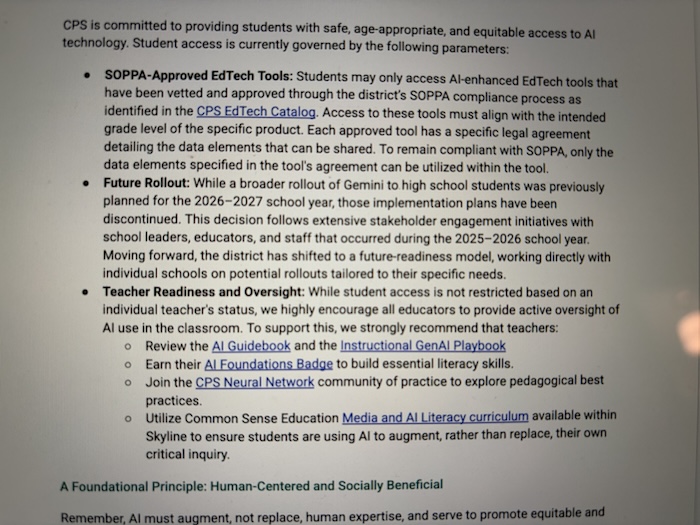
"Future Rollout: While a broader rollout of Gemini to high school students was previously planned for the 2026-2027 school year, those implementation plans have been discontinued. This decision follows extensive stakeholder engagement initiatives with school leaders, educators, and staff that occurred during the 2025-2026 school year. Moving forward, the district has shifted to a future-readiness model, working directly with individual schools on potential rollouts tailored to their specific needs."
Many questions remain:
-
Who made the plan to allow Gemini access and then made the decision to cancel it? If that decision, with significant pedagogical, legal and social-emotional impact, lies only within the Department of Information and Technology Services, that is problematic.
-
Who did the decision-makers engage with to change the plan? Why aren’t families and students listed as part of the stakeholders who were included?
-
What student data is Google receiving from CPS via what applications and what is Google doing with it? There are no data sharing agreements available in the CPS Ed Tech Catalog for Google products even though they are used ubiquitously in the district. Earlier this year, we noted that the catalog stated that teachers could enter student data into Google Gemini (and Microsoft CoPilot). Any product that is collecting or processing student data should be included in this catalog under the requirements of the state’s Student Online Personal Protection Act (SOPPA) .
-
CPS’ public statement only mentions disabling the Gemini chatbot application, but Gemini is embedded in many Google applications. Will those be part of a narrower rollout?
Note that the document "CPS AI Access Overview" is not accessible to the public nor to families, only to CPS staff and students even though it is linked to within the “CPS AI Guidebook”, a public document and one that itself is referred to in CPS Policy (here and here). This is not acceptable practice for a public institution.
Amira
Amira is a software product with an AI “learning agent” used for literacy instruction and assessment in elementary school. It records children’s speech, as young as kindergarten, as they read for practice and standardized testing purposes.
CPS claims that Amira is merely “a supplemental resource used within the District’s online policies.” However, Amira was one of two products highlighted in the CPS Budget Book this year (p.215) that the district funds centrally for assessment and struggling students:
"Student Assessment and MTSS: Through the renewal of the Branching Minds platform—which consolidates academic, behavioral, and social-emotional data via screeners like the DESSA and SRSSIE—the department provides the tools, guidance, and professional learning necessary to enact an equity-based MTSS framework with fidelity. Furthermore, educators will be empowered to analyze curriculum-embedded assessments and deploy District-funded interventions in math and reading. This includes Amira, an AI-powered reading tutor aligned with the Skyline curriculum and Summer Bridge, and Freckle, an adaptive math platform syncing with Star Math data to seamlessly target individual student learning gaps."
Use of Amira is also included in numerous schools' Continuous Improvement Work Plans, required as part of the district’s accountability policy.
Questions have arisen in other districts about Amira’s audio recordings of students’ voices. Recently, the New Mexico Public Education Department announced that school districts there could opt out of using the Amira literacy assessment as the state-required reading test for K-2nd grade.
The Los Alamos Public Schools Superintendent wrote in a letter in the Los Alamos Daily Post that the district was requesting to opt out of using Amira:
“A child’s voice is effectively biometric data, and parents are rightly uneasy about it being collected and retained by a third-party system as a condition of a state-mandated assessment. Until we can provide our district and families with clear, verifiable answers to these questions, we do not believe the state should require children to submit their voices to the platform.”
Under the Illinois School Code, 105 ILCS 5/34-18.34, CPS must get written permission from parents when students’ biometric information is collected, and biometric information can only be used for identification or fraud prevention.
It is unknown whether CPS students’ voices are being recorded when they use Amira, and whether this is taking place in compliance with the IL School Code’s restrictions on biometric information collection and use.
The data sharing agreement for Amira posted in accordance with SOPPA only says that “Student Generated Content” is shared with the vendor, with no details on the nature of that content.
About Illinois Families for Public Schools
###