
School is starting around the state, and here’s what we’re keeping tabs on with ed tech and school funding…
✶ Pushing back on Big Tech in our schools
As we shared earlier this month, IL-FPS developed a Pledge to Protect Human-Centered Education, and we’ve asked all the candidates running in the historic election of the full Chicago Board of Education to commit to it.
 So far, almost two dozen candidates have done so, across 15 of the 20 subdistricts and two of five candidates for Board President. You can read the pledge and an explainer here.
We’ve partnered with a new Chicago chapter of the national organization Schools Beyond Screens on a candidate tracker, which makes it easy to see and share where your candidates stand:
What are we asking candidates to commit to?
|
These policies aren’t a panacea, but together they’d lay the foundation for a real reckoning with the negative impact of tech on CPS kids’ education and their personal data.
There has been lots of discussion about the state of CPS’s budget as the school board campaigns heat up—see more on that below. But, along with voting on budgets and hiring and firing superintendents, school boards set district policy, so candidates should also be weighing in on these important policy issues.
If your candidate hasn’t committed yet to the Pledge, ask them! If you are having trouble finding their contact info, let us know. ([email protected]) Some campaigns are still hard to track down even though early voting starts in about six weeks. (The Chicago BoE newsletter Board Rule has been keeping track of candidate events if you want to meet and hear from candidates in person.)
✶ Help us say no to CPS rolling out Google Gemini in high schools!
As we were in the process of creating the Pledge, we learned that CPS is planning to give access to a general-purpose generative AI tool, Google Gemini, to all high school students this school year.
This is deeply concerning. CPS’ own guidance for teachers says Gemini and other genAI tools don’t have safety and guardrails sufficient for student use (p. 19).
Google’s marketing materials describe student use of Gemini for activities like solving homework problems and researching papers. Cognitive offloading is a major issue with use of genAI.
|
"When young people systematically use AI to complete schoolwork or other thinking tasks, they are not offloading skills they already possess. They are shortcutting the process of developing those skills in the first place. [...] Struggle, practice, mistakes, observation, reflection, and adaptation are not inefficiencies to be optimized away; they are the core of learning." -- Rebecca Winthrop, Brookings Institute |
If you’re concerned about outsourcing your child’s education to one of Big Tech’s bots, please take a minute to use this tool to write to CPS leaders and urge them to stop this rollout:
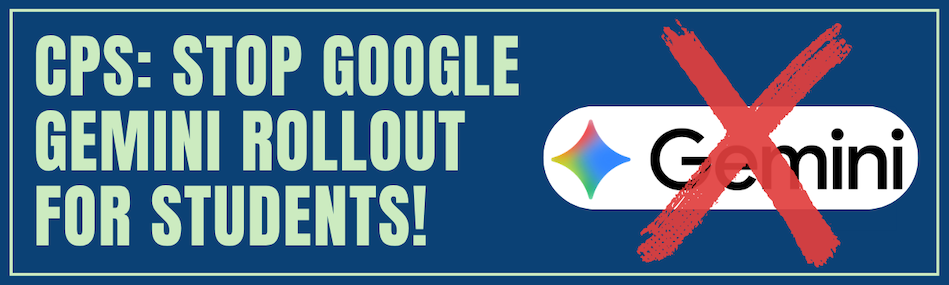
We’d like to see a full moratorium on genAI products in CPS until truly protective policies can be developed and put into place, but meanwhile, this is an urgent issue unfolding for the school year that’s about to start.
If you’re not in CPS, your district may already have been allowing students to use Gemini in their Google Workspace for Education student accounts. And the New York Times reported on Friday that Google is going to start allowing student access to Gemini by default in the Google Classroom app. Find out from your district what access is being given to students. Ask questions and demand clear answers.
The Illinois State Board of Education released guidance for school districts and educators on AI at the end of June, but it includes only a short section focused on specifics about district policies. IL-FPS' Cassie Creswell was on WBEZ’s In the Loop last week to talk about ISBE’s guidance and AI in schools, including our worries about CPS’ rollout of Gemini.
There is lots of organized pushback from parents on overuse of tech in schools taking place in and beyond Chicago right now:
Daily Herald - As new school year dawns, some parents urge schools to use technology less in classrooms
The Schools Beyond Screens CPS chapter is asking the current Chicago Board of Ed to limit screentime and re-evaluate ed tech software contracts. You can sign and share their “Petition for Intentional Technology Use in Chicago Public Schools” here.
In addition to CPS, Schools Beyond Screens has active chapters elsewhere in Illinois too. Screen Sense Evanston has been asking District 65 to limit time and spending on ed tech for many months. Distraction Free Schools Illinois has been active in the state-level push to restrict cellphone use in schools, culminating in legislation that the Governor signed last month, but they are also concerned about school-issued devices.
✶ When will we fully fund our public schools in Illinois?
The Illinois General Assembly ended its Spring session in May, passing a state budget which did include an increase in Evidence-Based Funding (EBF) for public schools, $350 million. That’s the annual minimum increase that legislators committed to back in 2017 when the new funding formula was passed. (Note that $350 million in 2017 dollars would be $475 million today…)
Unfortunately, 2027 was the year that we were supposed to reach full funding for public schools, and, based on the numbers ISBE released last week, we’ve only been getting further away from that goal for the last several.
Capitol News Illinois reported in detail on the State Superintendent’s briefing and what that EBF looks like for FY2027. The EBF changes each year because of changes in student population; costs, including teacher salaries; and local tax revenue (which still makes up the largest portion of public school budgets).
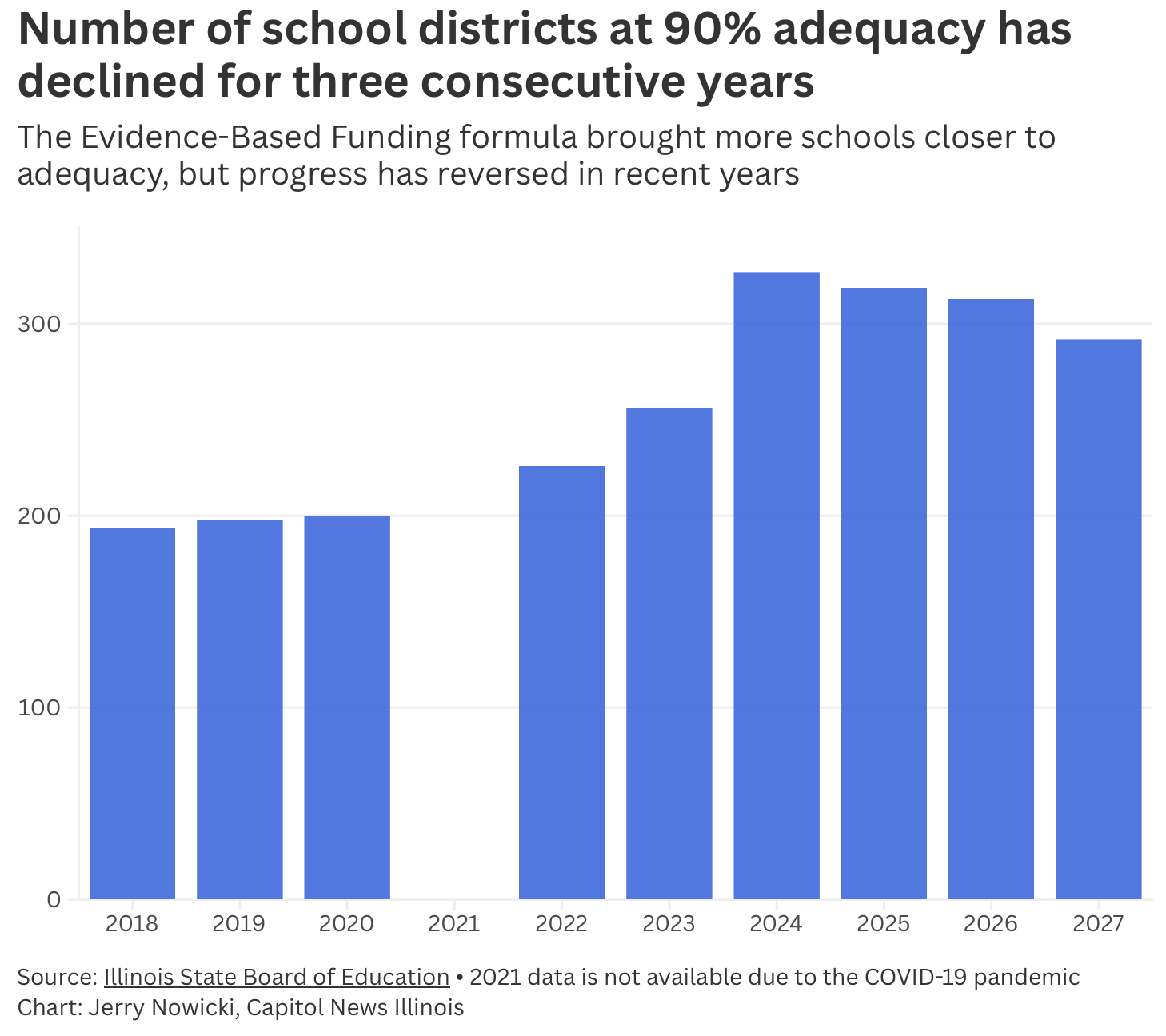
The takeaway: we’re still billions away from 100% full funding, and it will be another 14 years before we even get to 90% adequacy if the state continues to only increase EBF by the bare minimum each year.
We know what this looks like on the ground in schools—cuts and layoffs and an inadequate education for the State’s children in the majority of school districts.
Many districts across Illinois are dealing with budget shortfalls. Waukegan D60’s school board just voted for layoffs at the end of July, and many more were weighing similar decisions this spring for the coming school year—Mercer County, Rockford, Freeport, Evanston (high school and elementary district) Naperville, Indian Prairie, Wauconda, Springfield, Frankfort, Decatur.
In Chicago, the Board of Ed approved a school budget at the end of July that will only be balanced if the General Assembly votes to appropriate $150 million in additional funding during their brief Fall Veto Session. (Or, alternatively, if the amount CPS receives from the City of Chicago declaring a TIF surplus is significantly higher than what has been budgeted for.) If the State doesn’t come through with additional funding, it could mean furlough days or cuts at midyear. CPS' EBF adequacy percentage is just a hair over 70% this year.
Chicago Sun-Times Opinion: Ralph Matire - CPS budget challenges Springfield to pay up
But bills need to pass with a supermajority during Veto Session (vs. a simple majority from January through the end of May.) So, it would be an especially heavy lift politically to convince a supermajority in the GA to find additional funds just for CPS.
And the cost to increase the total EBF amount for all districts, such that CPS’ share increased by $100M, would be roughly several hundred million dollars more.
CPS’s approved budget is counting on an additional $50 million in state funding for mandated categoricals as well; these are underfunded in other districts as well.
The truth is we live in a wealthy state in a wealthy country. We can afford to give all 1.8 million kids in Illinois public schools the resources they need for the high-quality education they deserve.
We’re shortchanging them, and many other key public goods, because the wealthy in our state aren’t paying what they owe. We’re the eighth most regressive state, in terms of middle class and poor people footing the tax bill for what our state needs to function and flourish.
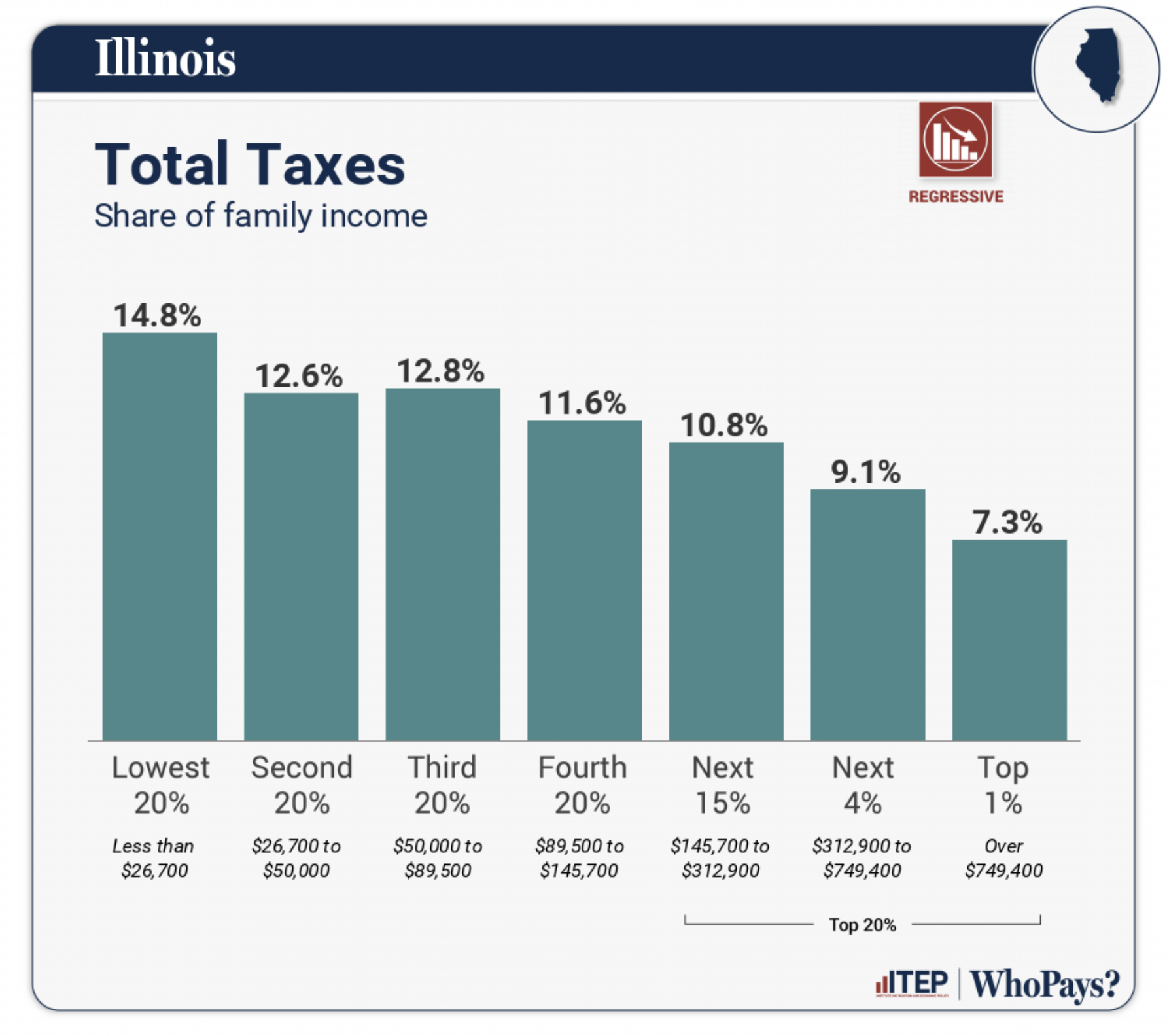
The Illinois Revenue Alliance has done effective work over the past few years advocating for new sources of progressive revenue, including a tax on digital advertising that passed this spring. Taxing digital advertising could be worth close to $1 billion/year in new revenue for the state. (However, the digital ad tax and another social media tax are likely to face legal challenges.)
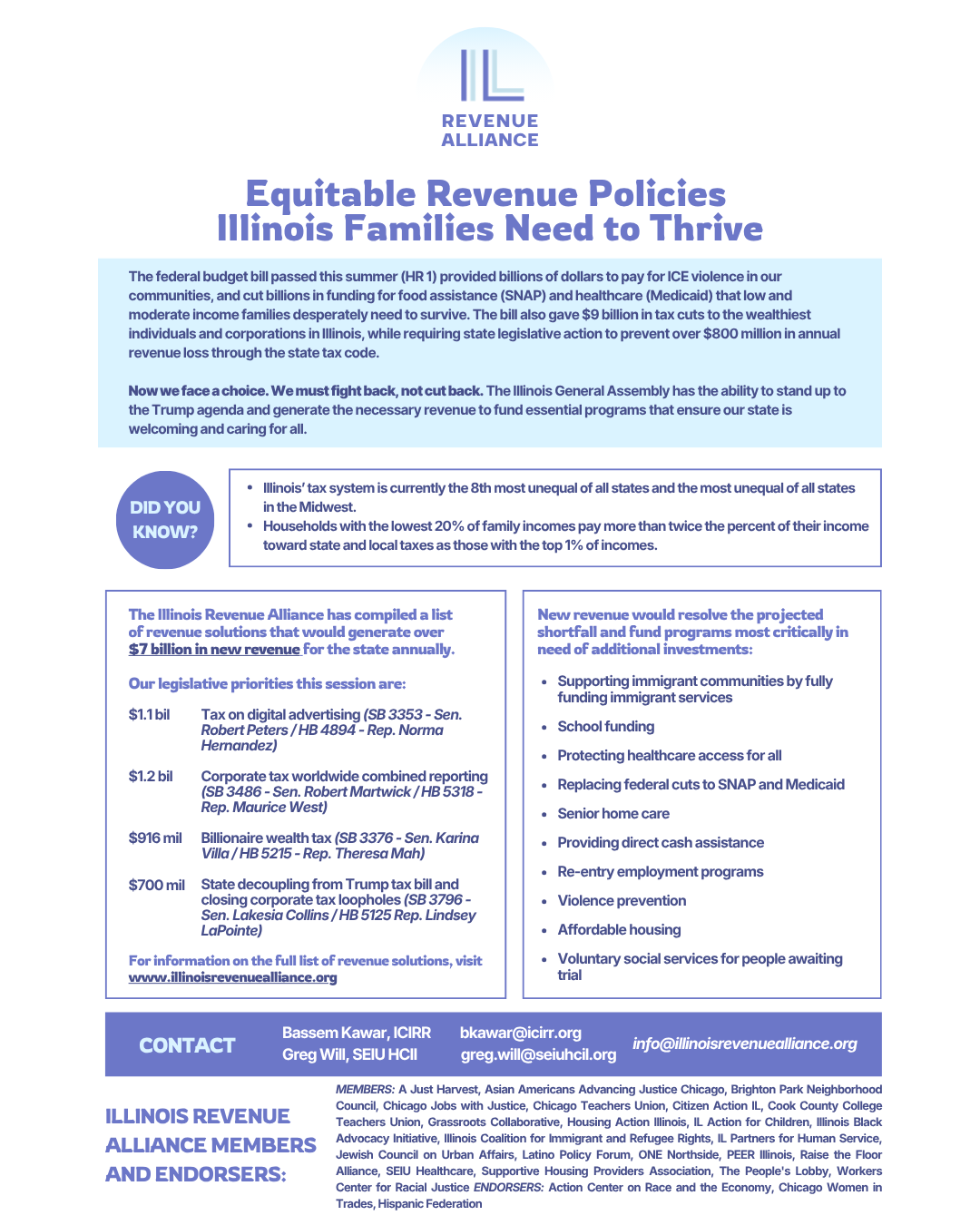
There are now more than 40 state legislators who are part of the Affordability and Tax Justice Coalition in the General Assembly, a group that was key in getting some of these progressive revenue measures into the FY2027 state budget. Ask your state rep and state senator if they belong to this group and encourage them to join if not!
✶ Save the Date - What to know about the federal voucher program
We’ll be holding an online forum about the new, harmful federal voucher program (yet another tax giveaway for the wealthy!) on the evening of Tuesday Sept. 15th. Governor Pritzker has yet to make a decision on whether Illinois should participate.
Unfortunately, there is a lot of misinformation circulating about how this program—designed and intended to unleash private school vouchers funded by tax dollars nationwide—will impact our public schools. This forum should help clear some of that up. Keep an eye out for a registration link later this week.
In the meantime, let others know this decision is on the table; share the facts with them about the voucher program via our zine (also available in Spanish) or via this Action Network page.
Thanks for your continuing advocacy at this busy time of year. Questions? Get in touch: [email protected]