
No matter their zip code, their religion, or their race, what most Illinois families want is a well-resourced public school right where they live and play, a school where every child is welcome and has the freedom to learn and grow. As an advocacy organization, we support bills that get us closer to that vision, and oppose bills that push that vision even further out of reach.
Under that rule of thumb, last summer we opposed the legislation that Congress passed to create a new and unprecedented federal voucher program that will send billions in tax dollars to private religious schools.
Thankfully, our state still has the power to decide whether or not to participate in that program.
There are currently two bills in the General Assembly sponsored by Democrats that would make that decision for Illinois.
Sen. Graciela Guzmán’s bill, SB 3966, would prohibit Illinois from participating in the federal program or any other federal voucher program going forward. Sen. Adriane Johnson’s bill SB 3776 would opt Illinois into the voucher program.
Opting into the federal voucher program will make it harder for Illinois to ensure that all families have fully-funded local public schools.
Voucher programs hurt public school funding, as we’ve seen around the country in recent years. They increase segregation. And they don’t improve educational outcomes…often making them drastically worse.
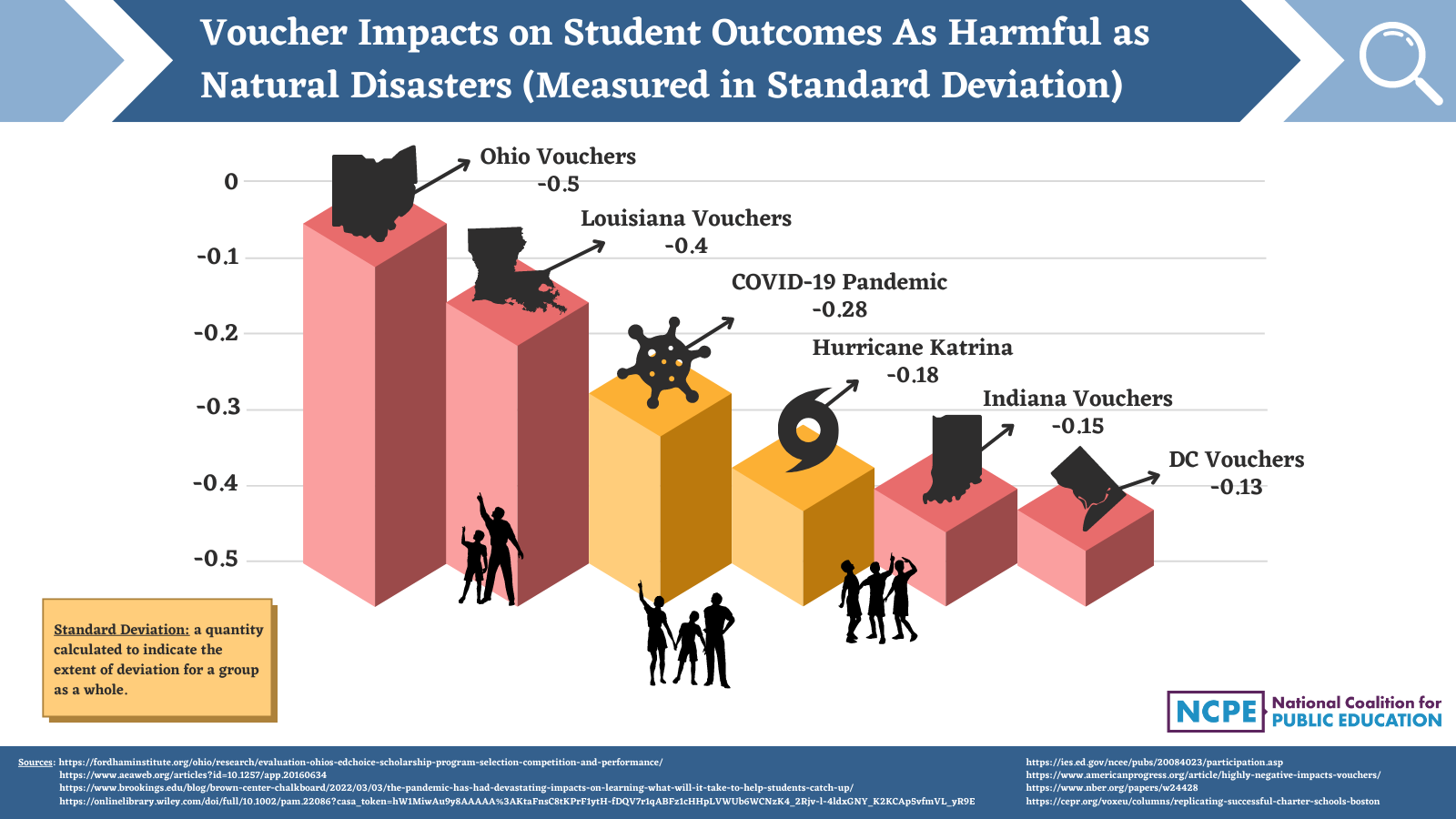
This new federal voucher program, which will be in the form of a tax credit scholarship program, will be no different. We have seen tax credit scholarship vouchers in Illinois before, and they funded discrimination and hurt equity. And, the $315 million Illinois spent during the six years of the program had little to no academic benefits for the children who participated, based on the scant information shared publicly.
Zooming in on the 30th Senate District
Taking a look at the district that Senator Johnson represents, we can see how the Illinois voucher program played out on the ground.
In the final year of the program about 290 students in District 30 received vouchers, about 85% of those students attended one of three schools, Cristo Rey St Martin College Prep, Most Blessed Trinity Academy and St. Anastasia Catholic School.
All three of these schools state publicly on their websites that they discriminate—excluding students who public schools in Illinois must serve under federal and state law:
- Cristo Rey St. Martin does not enroll undocumented students. All students at the school must work one day per week to pay for their tuition costs, and, according to an October 2025 post from the school’s president on their website, "[b]ecause of our Corporate Work Study Program at Cristo Rey St. Martin College Prep, all our students have the appropriate documentation to be able to work. All are United States citizens or legal residents."
- Most Blessed Trinity Academy, according to its parent and student handbook, discriminates against students with developmental and learning disabilities: “MBTA endeavors to educate all students within the limits of the school’s educational program. Children who are determined to be educable mentally handicapped or have a learning disability that cannot be handled in a regular classroom will not be accepted at the Academy.”
- St. Anastasia also discriminates against students with disabilities: "All new and transfer students are welcome and will be accepted on a probationary period of 60 school days at Saint Anastasia School. Students are expected to maintain passing grades during this probationary period, have no major discipline issues, or require accommodations that the school physically or financially cannot support. Students with special learning needs may be accepted if the school has the staff and ability to make the necessary accommodations for the child’s academic growth and success. During the 60 school day probationary period, if the school determines the student cannot perform with adequate growth in this environment or if behavior occurrences disrupt the school day, the student may be asked to unenroll and any prepaid tuition will be prorated and refunded."
According to the Illinois State Board of Education, in the 2024-2025 school year, none of these schools reported serving any special education students.
So, while those students who received state vouchers to study at those schools may have thrived, as public education advocates, we’re more concerned about the roughly 35,000 students who attend public schools in the 30th Senate district:
- Almost 1 in 5 have a disability
- 13% have Individualized Education Programs
- 45% of students come from low-income households
- 36% are English-language learners
- About 70% are in school districts that are not fully funded
Almost a decade after the General Assembly passed a new evidence-based funding formula, the students in the underfunded school districts are still missing more than $130 million.
They deserve better—particularly the almost 15,000 students in Waukegan D60 and North Chicago D187, districts that are shortchanged by more than $5,500 per student!
That’s not right!
Back to the federal voucher program…
Supporters say some of the federal voucher dollars might go to public school students. But the reality is that the vast majority of dollars will go to private, religious schools that will pick and choose who they enroll, and most vouchers will go to families who were already sending kids to private school.
Funding that does go to public school students will likely end up in wealthy school districts, as we saw in a similar program in Arizona, where five times as much money went to the wealthiest school districts as went to the poorest.
Public school students in the 30th Senate District and around the state need their schools to have full, equal, stable funding.
A tax gimmick dependent on the whims of those wealthy enough to divert what they owe to the feds and wait for a tax credit the following April, isn’t a solution.
This makes it easy to know which of SB 3966, and SB 3776 to support and which to oppose: Sen. Guzman’s SB 3966 will protect our public schools from defunding and protect Illinois kids from discrimination. Sen. Johnson’s SB 3776 won’t.
|
☞ Call your own State Senator this week and ask them to co-sponsor SB 3966 to keep vouchers from coming back to Illinois. Find their district and Springfield office numbers here. Here's a fact sheet to share with legislators which covers both bills: No federal vouchers for Illinois! |
So how should we fund public schools?
Illinois needs progressive revenue sources that schools can count on from year-to-year that covers everything we know that kids need to learn and thrive. Millionaires, billionaires and corporations should pay their fair share so we can make that vision of fully funded local schools in every community a reality. Speaker of the House Chris Welch floated the idea of a millionaire's tax earlier this year, It worked in Massachusetts. Call the Speaker and ask when he’ll be introducing a resolution to get this done: (217) 782-5350